Calculated bottle path
- Circumference
- —
- Planning label length
- —
- Usable label height
- —

Bottle and label measurements
Estimate a planning label size, then record the physical label zone, clearances and reel information needed for a useful bottle labelling machine enquiry.
Need a bottle labeller specified? Send the marked bottle, proposed label size, roll data and production requirement.
Request specification adviceCall 01494 623015For a genuinely round label zone, circumference is π × diameter. A wrap label can then be planned as the measured circumference minus a deliberate gap, plus a deliberate overlap, or as a chosen percentage of the circumference. Label height should stay within a stable straight-wall area unless a representative trial proves otherwise.
Measure at the height where the label will run, not at the bottle's widest point unless those are the same location. A flexible tape around the real bottle is normally more useful than a nominal catalogue diameter because the finished pack may be out of round, moulded with seams or ribs, flexible after filling, or slightly tapered.
For flat, oval and shaped bottles, do not treat circumference as the only dimension. Record the usable front and rear panels, the bottle datum used for orientation, radii at the panel edges and the finished label relationship.
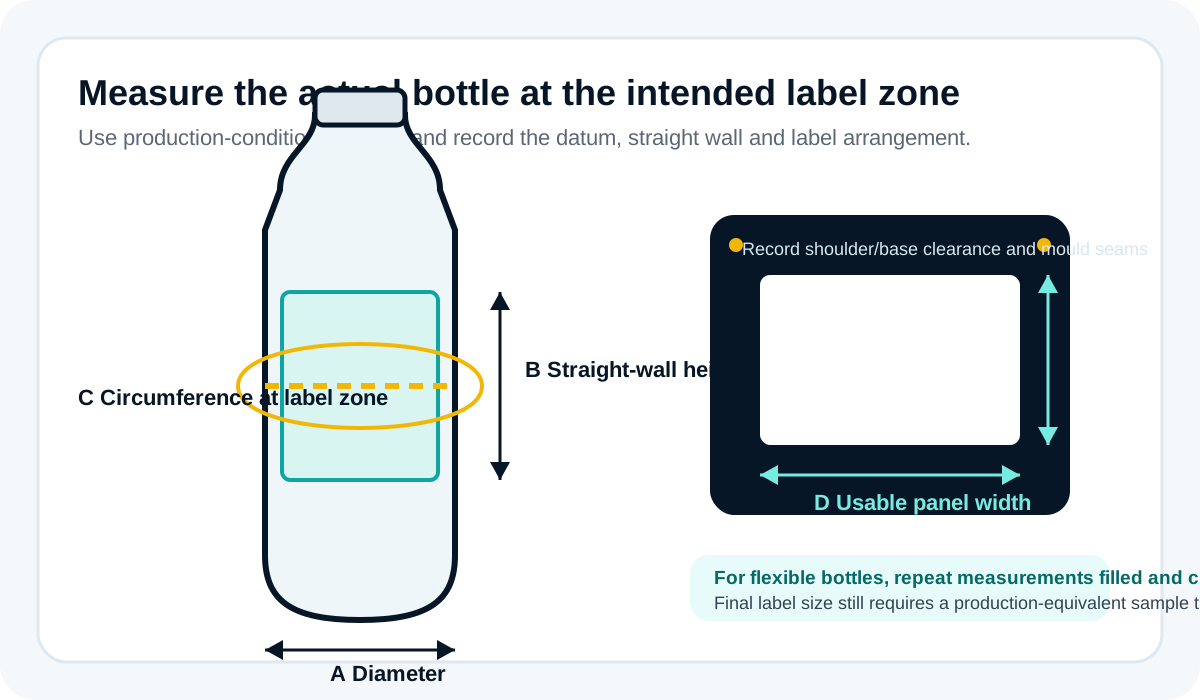
Use millimetres or inches. Enter either the diameter or a measured circumference. The result is an estimate for planning and must be checked against actual bottles, artwork, label-converter tolerances and the intended machine.
—
Keep the result with the physical sample and mark the exact height at which the measurement was taken.
Measure the finished production pack, including its normal fill and closure where these affect rigidity or orientation.
| Container or label route | Primary dimensions | Additional decision |
|---|---|---|
| Round wraparound bottle | Circumference at the label zone and usable straight-wall height. | Gap or overlap, seam position, bottle rotation and barcode orientation. |
| Front label on a round bottle | Chosen label width as a percentage or chord of the available curved area, plus usable height. | Visual centring and the amount of curvature accepted under the label. |
| Flat or square bottle | Usable panel width and height inside the corner radii. | Bottle orientation datum and clearance from panel edges. |
| Oval bottle with front and rear labels | Front and rear panel widths, heights and their relationship to one datum. | Orientation method, side gaps and label-head registration. |
| Tapered or compound shape | Width or circumference at several heights and the angle of the label zone. | Whether a flat pressure-sensitive label can apply without wrinkles or whether artwork, label shape or technology must change. |
Use these answers to prepare the artwork and machine brief, then validate the complete pack with the label converter and Lancing.
Not necessarily. A full wrap may use a deliberate gap or overlap, while a front label covers only part of the circumference. The required dimension also depends on bottle variation, seam position, artwork and the accepted finished appearance.
Use a measured circumference at the intended label height where possible. The π × diameter formula is suitable for a planning estimate on a genuinely round section, but it cannot capture taper, mould variation or an out-of-round filled bottle.
There is no universal gap. It must remain acceptable across bottle, label and application variation, while protecting artwork and barcode areas. Define it as an acceptance criterion and prove it with production-equivalent samples.
Measure circumference or width at several heights across the proposed label zone. A flat rectangular label may wrinkle or skew on changing geometry, so the label shape, artwork or labelling method may need to change after a sample trial.
It may be possible on a proven pack and label construction, but changing geometry increases the risk of wrinkles, edge lift and inconsistent wipe-down. Keep the planning label inside a stable panel unless testing supports another result.
No. It creates a planning estimate only. Final suitability depends on the real bottle, label material, adhesive, liner, reel, sensing method, application pressure, production environment and agreed acceptance test.
Continue with the label-roll specification worksheet, clear-label sensing guide and sample-testing checklist.
Include circumference or panel measurements, usable height, gap or overlap, reel data, batch requirement and the required finished-pack checks.